


By Pratap John/Chief Business Reporter
Renminbi is fast emerging as a global trade currency and its internationalisation trend reflects China’s status as a global economic power and will support its growing trade and investment relationships worldwide, a senior HSBC economist has said.
HSBC chief economist (Mena) Simon Williams said by 2015 the bank expects that around 30% of China’s total trade (equivalent to around $2tn) will be settled in renminbi (RMB), which in Chinese means “people’s currency”.
Globally, the use of RMB has been increasing since 2009, when China launched a pilot programme to internationalise its currency by allowing the RMB to be used to settle cross-border trade. Since then, China’s trading partners have increasingly been able to use the RMB when paying for imports or receiving payments for exports.
Since the launch in 2010, the tradable RMB has strengthened against the dollar by almost 8%.
This process of the growth of the RMB has been accelerating principally from the growth in trade settlement. In 2012, 12% of China’s total trade (imports and exports) was paid for in RMB, up from 3% in 2010, Williams said at a presentation in Doha yesterday.
There are more than 30 markets worldwide conducting more than 10% of their business with China in the currency and the RMB cross-border capital flows have also taken off.
FDI inflows on renminbi almost tripled in 2012 while RMB outward direct investment (ODI) surged by 50%.
In parallel, RMB investment opportunities are opening up all around the world – supported by thriving offshore markets that are expanding offshore hedging, fundraising and other financing needs denominated in RMB, Williams said.
On how the Middle East would benefit from China’s growth and Renminbi’s internationalisation Williams said: “Countries in the region, oil exporters in particular, will see more exports to China due to the surging demand for energy in the rapidly emerging Asian giant.
“Even as western economies have stagnated, the oil price is remaining around $100 a barrel. The current high oil price is due to rapidly growing energy demand in China, India and other emerging countries,” Williams said.
“The Middle East is becoming a major beneficiary of that growth. Trade between China and 16 of the largest Arab states grew from $13.5bn in 2001 to $182bn in 2011,” the HSBC economist said.
Customers in Qatar, as well as in the UAE, Bahrain, Kuwait and Lebanon are able to conduct RMB cross-border payments for settlement of trade transactions, and to place remunerative term deposits in RMB.
“The longer-term perspective is that in five years’ time, using the RMB is going to be a requirement for any Middle East firm serious about developing its trading links with China,” he said.
As a global leader in trade finance, HSBC is helping to internationalise the currency. As the biggest bank in Hong Kong and the leading international bank in China, HSBC is well placed to do so, he said.
Asked what would happen to the dollar peg of Gulf currencies in the context of renminbi growth, Williams said, “We do not expect any change in the foreseeable future in terms of dollar peg. But the role of dollar will diminish and renminbi grow in the long term,” Williams said.
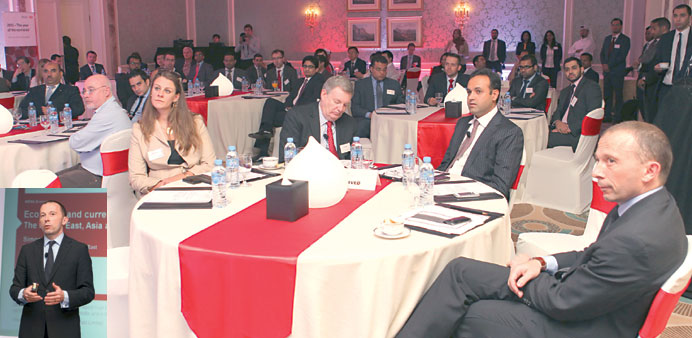
At the session HSBC executives, Ian Rogers, Adnan Ahmed and Praveen Gupta spoke on topics such as trade and receivable finance, payment and cash management and global markets.