


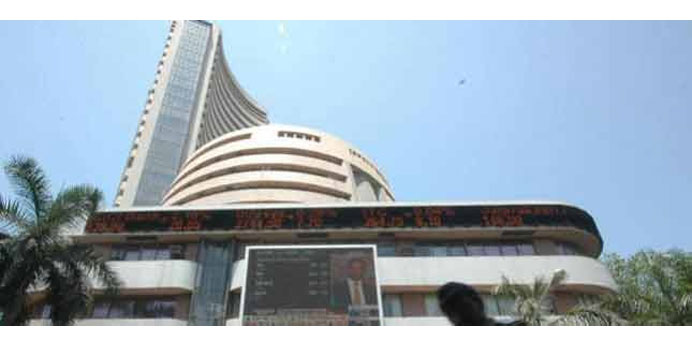
Bloomberg/Mumbai
Indian stocks completed their first weekly drop in six amid speculation global central banks may wind down stimulus, cooling demand for emerging-market assets.
The S&P BSE Sensex swung between gains and losses at least 20 times before closing 0.2% higher at 19,704.33 in Mumbai yesterday, its first gain in five days. The gauge lost 2.9% this week, the most since the period ended March 22. Tata Steel climbed 4.5% after Thursday reporting a lower-than-estimated quarterly loss. State Bank of India posted its biggest two-day decline since November 2011.
Bank of Japan Governor Haruhiko Kuroda said yesterday the central bank had announced sufficient monetary easing. The Topix index swung wildly following its 6.9% plunge on Thursday, when global stocks slid after Fed Chairman Ben S Bernanke’s signal that bond purchases may be tapered if the US labour market continues to improve. The Sensex ended a fifth week of gains on May 17, rising to its highest level since January 5, 2011.
“The biggest risk for India is the liquidity-driven trade tapering off,” Andrew Holland, chief executive officer at Ambit Investment Advisors in Mumbai, said in an interview to Bloomberg TV India. “We expect to see a larger correction.”
The Sensex has rebounded 8.1% since retreating to a seven-month low on April 9, as foreigners boosted their equity purchases amid easing by central banks from India to Europe and a drop in oil and gold prices. Imports of the two commodities helped fuel India’s current-account deficit to a record $32.6bn in the December quarter.
Foreigners were net buyers of local stocks for a 25th day on May 23, the longest run since the 35 days through February 15, data from the regulator show. That’s taken their net investment into Indian equities this year to $14.6bn, a record for the period, data compiled by Bloomberg show.
Tata Steel, the nation’s biggest producer of the alloy, climbed 4.5% to Rs313, the most since September 14. It posted a group net loss of Rs65.3bn after a non-cash write down and falling prices in Europe. The mean estimate in a Bloomberg survey was a loss of Rs81.2bn.
State Bank lost 1.2% to Rs2,151.20. It sank 7.9% on Thursday after saying fourth-quarter net income fell 19% from a year ago to Rs33bn as bad-debt provisions rose. Profit was below analysts’ estimates.
Profit at four of the 21 Sensex companies that have posted March-quarter results so far has trailed analysts’ estimates, data compiled by Bloomberg show. The scorecard excludes Tata Steel, which posted a loss. Net income at about 43% of the 30 index firms missed forecasts in the three months ended December 31, compared with 40% in the previous two quarters.
Tata Motors, the owner of British luxury car brands Jaguar and Land Rover, slid 1% to Rs288.10 in a seventh day of losses, the longest losing run in three years. Sun Pharmaceutical Industries, India’s largest drugmaker, sank 3.7% to Rs968.85, the most since May 9, after unit Taro Pharmaceutical Industries’s earnings.
Larsen & Toubro rebounded from its biggest two-day decline since 2009, jumping 2.7% to Rs1,456.80. ICICI Bank, India’s largest private lender, jumped 2.7% to Rs1,204.15, the most since May 15.
The Sensex has risen 1.4% in 2013 and trades at 13.5 times projected 12-month profits. Volume on the gauge was 19% higher than the 30-day average at the close. The 50- stock CNX Nifty Index on the National Stock Exchange added 0.3% to 5,983.55 to pare its weekly loss to 3.3%. Its May futures settled at 5,985.40.
The Sensex’s five-week winning streak was its longest since October last year.
Meanwhile, India’s rupee completed a third weekly decline after the Federal Reserve indicated it may slow debt purchases, fuelling concern that fund flows to emerging markets will reduce. Bonds gained for an eighth week.
“Concerns that inflows will be affected if the Fed reduces stimulus are keeping the rupee subdued,” said Paresh Nayar, head of money markets and currency at FirstRand in Mumbai. “India needs sustained capital flows to offset the shortfall in the current account.”
The rupee weakened 1.4% this week and 0.1% yesterday to 55.6450 per dollar in Mumbai, according to data compiled by Bloomberg. It touched 56.0145 on Thursday, the lowest level since September 6. One-month implied volatility, a gauge of expected moves in the exchange rate used to price options, rose 55 basis points, or 0.55 percentage point, this week to 9.0225%.
India’s current account deficit reached a record $32.5bn in the three months through December, official data show.
Three-month onshore rupee forwards traded at 56.52 per dollar, compared with 55.79 at the end of last week, according to data compiled by Bloomberg. Offshore non-deliverable contracts were at 56.57 versus 55.94.
India’s wholesale price index climbed 4.89% in April from a year earlier, the least since November 2009, official data showed last week, spurring speculation of further central bank rate cuts. The Reserve Bank of India has reduced the repurchase rate by 75 basis points this year to 7.25%.
The yield on the 8.15% government bonds June 2022 dropped seven basis points this week to 7.34% in Mumbai. The rate fell six basis points yesterday.
The five-year interest-rate swap, a derivative contract used to guard against fluctuations in funding costs, rose one basis point this week to 6.77%, according to data compiled by Bloomberg.
“The fundamentals are for lower bond yields and swap rates amidst sluggish growth momentum and easing inflation of late,” Citigroup analysts including Singapore-based Gaurav Garg wrote in a research note. “We recommend being long rupee bonds and receiving five-year swaps.”