


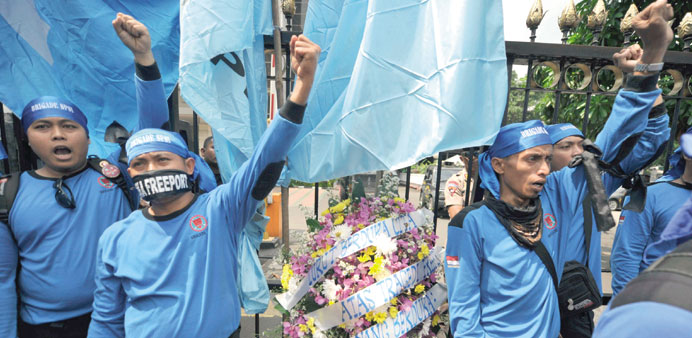
Indonesian workers union members hold a rally outside the energy and mineral resources ministry in Jakarta yesterday to demand safer working conditions after an accident on May 14 at the Freeport-McMoRan’s Grasberg mine.
Reuters/Jakarta
Freeport McMoRan Copper & Gold Inc’s Indonesian mine could face a prolonged closure and scrutiny over its underground mining plans after one of the country’s worst-ever mining disasters, analysts and mining sources said.
The Arizona-based company closed the world’s second-largest copper mine on Wednesday last week, a day after a training tunnel away from its main operations fell in on 38 workers. The death toll has climbed to 21, while ten have been rescued and seven remain missing.
The incident’s impact on global copper supply has so far been limited as the Grasberg mine complex keeps stockpiles in reserve in case of disruptions, but that would change if the closure drags on.
“You have to think that is not something that is going to be resolved overnight, said Gayle Berry, an analyst at Barclays in London.
“The danger is that if Freeport do try to re-start Grasberg too early, they might inflame already quite tense labour relations at a period when they are meant to be negotiating with unions,” she added.
Freeport said it would only reopen with government permission.
“When we ... resume operations, we will also have to consult with the ministry of mines,” Freeport spokeswoman Daisy Primayanti at the start of the week.
Indonesian President Susilo Bambang Yudhoyono called for an investigation and for rescue efforts to be intensified in a Twitter message last week, urging companies in the country to improve safety for workers.
Indonesia’s mining sector has a poor safety record after a series of previous accidents including an explosion at a coal mine in Sumatra that killed at least 28 people in 2009 and a landslide in 2006 that killed eight.
The government last week banned underground operations at the West Papua mine, Primayanti said. Most metal at the facility, in one of the most remote regions of the Indonesian archipelago, is currently extracted from an open pit but the company plans to increase the share from underground mining.
“Politically, they would have to leave the operations suspended until the last of the bodies are recovered ... The only nearby issue is how long until they restart. I’d say that will be a number of days,” said a senior mining industry source.
“The bigger strategic question is what is the implication for the development of the underground mining operations and therefore to Freeport’s targeted production levels as it moves into an underground phase,” said a mining industry source with knowledge of the sector in Indonesia
“Are there issues with the ground conditions or rock mechanics that the Freeport engineers don’t understand?”
Investors are also concerned the accident could further strain relations between the company and trade unions after a three-month strike in late 2011 and smaller disputes since.
A union leader last week demanded that Freeport keep the mine closed while the cause of the accident was investigated.
Separately, Indonesia’s largest workers’ union, the Indonesian Trade Union Confederation, held a small demonstration of about 25 outside the mining ministry in Jakarta over the disaster yesterday.